


The Sound of Courage Festival Berlin 2026: Review from Kesselhaus

Five artists from Iceland, Denmark, Finland, Sweden and Norway brought Nordic folk, electronic music and experimental sounds to Berlin’s Kesselhaus.

There is a particular kind of silence that only happens when an audience is completely engaged. At the Kesselhaus in Berlin on September 27, people sat closely together while others stood at the back, unable to find a seat. The room was full but quiet. Some had come alone. Most of the audience appeared older and relatively homogeneous, with the feeling of a crowd that had come specifically to listen. That concentration suited the room. The industrial atmosphere of the Kesselhaus gave the evening a physical weight of its own, while the sound was remarkably full and well balanced throughout the space. "The Sound of Courage: The Festival" was presented as the musical highlight of the accompanying programme to the exhibition "The Sound of Courage - Music and Equality in the Nordic Countries". The question behind both was simple: what does courage sound like, and what role can music play in the fight for equality? For two and a half hours, the answer kept changing.
The festival was the live extension of the exhibition "The Sound of Courage – Music and Equality in the Nordic Countries", which I had previously visited at Felleshus.
Lúpína: A Cold, Hypnotic Beginning (Iceland)

Lúpína opened the evening alone on stage, surrounded by synthesizers, computers and a drum machine. Her voice was delicate but never fragile - soft, confident and capable of suddenly becoming powerful. The synths were hypnotic, the beats dark and heavy and the songs rarely followed an obvious conventional structure. Instead, sounds seemed to build on top of each other, creating atmosphere rather than following a predictable verse-and chorus pattern.

At times, she used a voice transformer and sang through two microphones, changing the texture of her voice. The beats were produced live, making the electronic setup feel less like backing track and more like an instrument in itself. The effect was strikingly cold. There was something Nordic in the sound that could almost be felt physically. The lighting reinforced it: blue and purple tones kept the stage in a deliberately cool atmosphere. The final song, which I heard announced as “The Dream”, was particularly intense. Its combination of synths and vocals created an almost paralysing atmosphere: dark, suspended and hypnotic. Even visually, Lúpína resisted anything conventional. A tracksuit jacket was combined with a tulle skirt and futuristic tights, while silver square elements hanging across the outfit moved with her. It was an unusual way to begin the evening: intimate, electronic and entirely self-contained.
Ydegirl: Nordic Warmth (Denmark)


Ydegirl shifted the atmosphere almost completely. With a guitarist beside her and a synthesizer on stage, the performance was quieter and warmer. Both musicians were dressed casually, creating a visual contrast to the more constructed appearance of the opening set. The sound moved between an analogue-feeling synthesizer and clean, picked guitar. Some songs were reduced almost entirely to guitar. Later, Ydegirl also played bass, while electric guitar occasionally introduced a slight distortion. Her voice was the centre of it all: warm, soulful and expressive, with a wide range and very little obvious processing. There was something traditional about the music, but not in a way that felt nostalgic. Instead, the combination of acoustic instruments, electronics and her voice created a sense of Nordic warmth and melancholy. Nothing rushed. There was not a single fast song. The set stayed within the same quiet, atmospheric world, creating another intimate moment between performer and audience.
Vilma Jää: When the Audience Becomes Part of the Music (Finland)


With Vilma Jää, the room changed immediately. Rhythm and pop elements arrived almost at once. The synth-driven beats were physical - music that moved into the legs rather than simply staying in the head. Jää’s voice is unusually high, clear and instantly recognizable. At times, she moved into atmospheric high vocal passages that gave the music an almost cinematic scale. Traditional and folkloric elements were still present, but they were pushed into something thoroughly contemporary. And this time, the audience was no longer simply listening. Jää repeatedly addressed the crowd. During the second song, she asked them to shout along with the chorus. They did. The room suddenly became louder and more physical. The performance grew from there. Jää played violin, including passages where the instrument was picked rather than bowed, while her DJ also played flute and contributed backing vocals. The combination created an unusual tension: high vocals, violin and flute sitting over electronic rhythm. There were moments that evoked Viking music, but also something cinematic and epic. By the end, Jää asked the audience to stand and dance. Everyone did. The reaction was immediate and enthusiastic. After the stillness of the opening sets, the transformation was almost surprising.
Sara Parkman: Tradition With Weight (Sweden)


Sara Parkman brought the evening back toward its roots. The violin was central from the beginning, alongside a powerful, clear voice. The music sounded deeply connected to folk traditions, at times evoking old Nordic songs and the feeling of something passed down through generations. There was an unexpected detail behind the performance: Parkman’s pump organ had been lost at the airport, so the band was using a replacement instrument they did not actually know. It worked. The organ created a dense, unusual layer beneath the violin and voice. Synthesizers added low bass frequencies, while guitar and choir-like vocals expanded the arrangements. The combination of plucked violin and restrained beats created another distinctly Nordic atmosphere - cold, expansive and almost cinematic. One song about birth carried so much tension and force that the subject stopped feeling abstract. It became physical. That was one of the evening’s recurring qualities: the music did not always need to be understood lyrically to communicate something emotionally. Parkman’s set ended in standing ovations.
Lindy-Fay Hella & Sondre Veland: Into the Ritual (Norway)

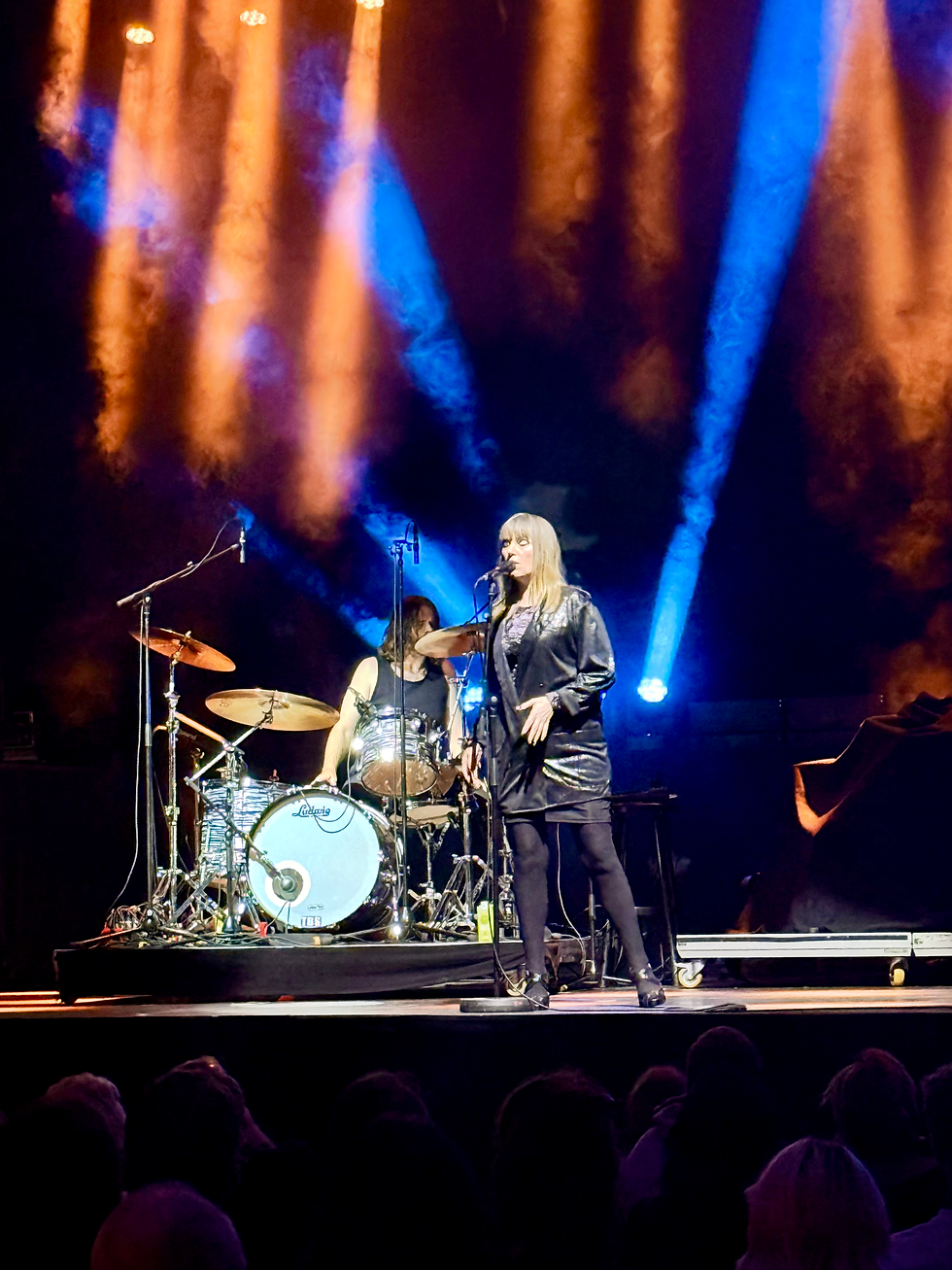
By the final performance, the audience had been listening for hours. Lindy-Fay Hella and Sondre Veland closed the night with something darker and more elemental. The drums were atmospheric rather than simply rhythmic. Deep bass, synthesizers and Hella’s high, powerful voice created a sound that felt simultaneously cinematic and ritualistic. Veland contributed backing vocals, while Hella moved between strong, soaring passages and quieter, whispered moments. Some sections approached darkwave or synthwave. Others felt much older, as if the electronic instruments were simply providing a modern framework for something ritualistic. The balance of the mix mattered here. The drums were powerful without overwhelming the voice, while the low bass and deep electronic sounds gave Hella’s high register even more impact. The result was hypnotic. After five very different performances, the audience was still completely focused.
What Does Courage Sound Like?
The interesting thing about "The Sound of Courage" was that the five performances never sounded like variations of the same idea. Lúpína’s electronic darkness, Ydegirl’s warmth, Vilma Jää’s physicality, Sara Parkman’s connection to folk tradition and the ritualistic atmosphere of Lindy-Fay Hella and Sondre Veland all occupied very different spaces. Yet there were connections everywhere: tradition meeting modern production, unusual vocal techniques, acoustic instruments placed alongside electronics and music that seemed to create images before words had a chance to explain them. For me, that is when music works best. When a song creates an image in my head, I know something is happening. When it communicates a feeling without me necessarily understanding every word, when something reaches you somewhere deeper than language, the music has already done its job. This evening created many of those moments. It also offered a kind of introduction to a culture I had previously known only superficially. By the end of the night, Nordic music felt less distant - not because it had been explained, but because I had spent several hours inside its different interpretations. The connection to the exhibition was therefore clear in one sense: the festival introduced its audience to artists, traditions and perspectives they might not otherwise have encountered. The question of equality, however, was less visible during the concerts themselves. The program description explicitly positioned the festival as an extension of the exhibition’s questions around music and equality. But watching five highly individual female artists perform, I did not constantly experience their work through that particular lens. I saw musicians who had their own artistic language, their own authority and their own reason for being on that stage.
Perhaps that is also part of the point. The evening did not need to repeatedly explain why these artists belonged there. They simply performed. And they were good. Very good. The strongest impression was not that the program was making five artists fit one theme. It was that the curation allowed five very different musical worlds to exist next to each other without a single moment feeling unnecessary. The announcements between performances, delivered by different members of the curatorial team, added another layer to the evening and helped give the festival a sense of progression. By the end, the Kesselhaus had moved from near silence to dancing, from electronic abstraction to folk tradition, from intimate voices to something almost ritualistic. Five artists. Five interpretations of the North. And one evening that never felt repetitive.
The festival was ultimately less an explanation of the exhibition’s questions than an experience of the music itself. For the background to the project and the exhibition, read our report from Felleshus.


Comments