


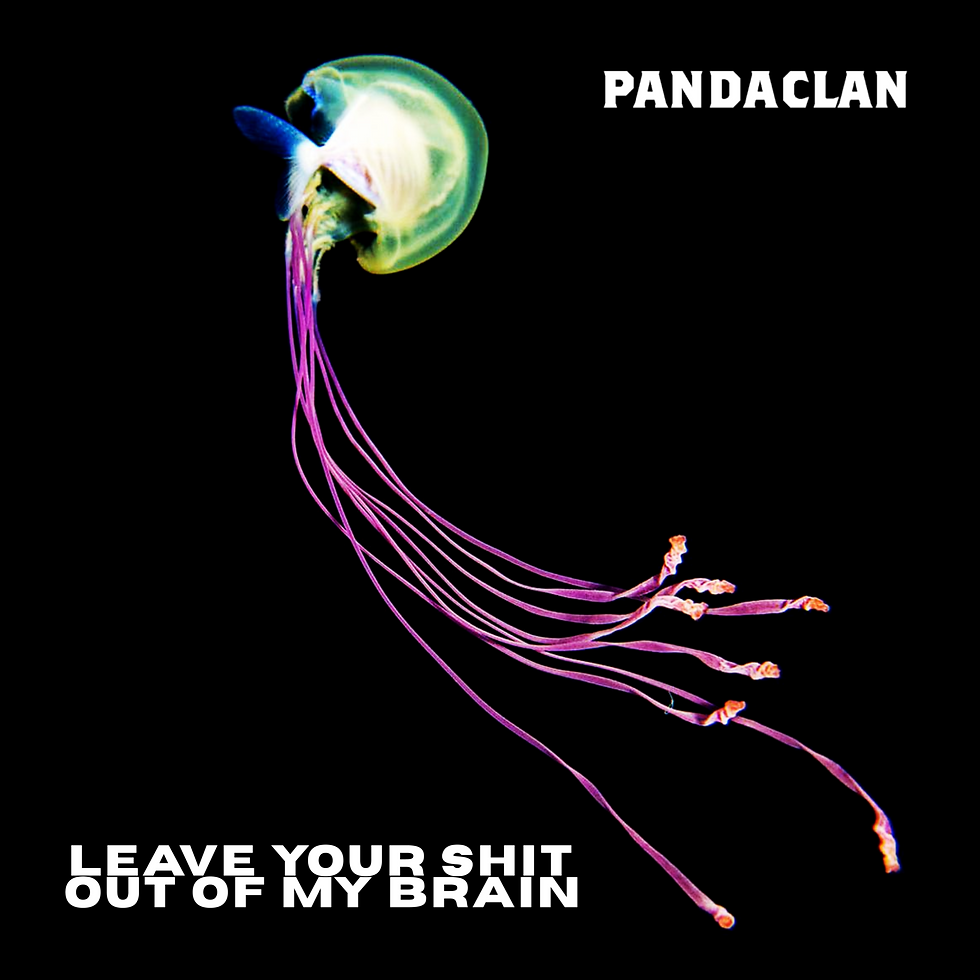
Between Resistance and the Infinite Scroll: Panda Clan - "Leave Your Shit Out Of My Brain"

On attention, visibility and cultural resistance in the platform age
Editorial Review | Partner Feature
Political music often struggles with a familiar problem. The stronger the message becomes, the easier it is for the music itself to disappear behind it. Panda Clan largely avoid that trap. On "Leave Your Shit Out Of My Brain", the Milan collective use electronics, dub and metal not simply as vehicles for political commentary, but as tools for creating tension, unease and confrontation. Repetition, momentum and layered textures run throughout the record, while spoken passages, screamed vocals and metallic synthesizers create an atmosphere that feels both hypnotic and unsettling.

Across eleven tracks, the album turns its attention towards surveillance culture, digital control, greenwashing and rising authoritarianism. Yet its strongest moments emerge when these themes become audible within the music itself. Rather than separating message and sound, Panda Clan allow both to reinforce one another, creating a record that feels less like a manifesto and more like a reflection of life inside systems increasingly shaped by distraction, visibility and control.
"Poppy Fields" and the Persistence of Resistance
The album opens with ”Poppy Fields”, a track built around movement rather than disruption. The track opens with a rhythmic synth pattern that quickly establishes itself as the song's central musical anchor. Fast, accented drums enter early, while bass and percussion continuously push the arrangement forward. A second synth layer gradually joins the mix, creating a metallic texture that comes to dominate much of the song's sonic identity.
Compared to the tension that defines many moments across the album, "Poppy Fields" feels more direct. The vocals are noticeably more melodic, while electronic kick drums maintain a constant sense of movement beneath them. Effects such as reverb and delay expand the vocal space, giving the track a wider and more atmospheric character without reducing its intensity.
What stands out most is the song's consistency. Rather than continuously increasing tension, "Poppy Fields" sustains it. The energy level remains remarkably stable from beginning to end, creating a feeling of persistence rather than escalation. That approach becomes particularly effective during the bridge. Spoken vocals repeat a single line while voices seem to emerge from multiple directions across the stereo field. When the driving drums return, the song reaches its emotional peak not through surprise, but through accumulation. The final moments leave behind metallic synthesizers and distant screams, suggesting that the tension never fully disappears. According to Panda Clan, the song uses poppies growing between railway tracks as a symbol of resistance within systems built around control, surveillance and endless productivity. Musically, that idea feels embedded in the song itself. "Poppy Fields" does not sound like a dramatic act of rebellion. It sounds like endurance. The refusal to disappear. The decision to remain present despite constant pressure to conform.
Stream "Poppy Fields" on Spotify
"Incudine" and the Sound of Contradiction
Among the album's most striking moments, "Incudine" balances two impulses that rarely sit comfortably together. The track feels confrontational and strangely danceable at the same time.
A recurring synth pattern runs through much of the song while electronic drums establish a driving rhythmic foundation. Screamed vocals appear almost immediately, yet the groove never fully collapses into aggression. Instead, the track repeatedly returns to movement. The beat remains persistent, sometimes even club-oriented, creating an unusual tension between physical momentum and emotional discomfort. Much like other moments on the album, the vocal delivery plays a central role. Spoken Italian passages dominate large sections of the track, often approaching a hypnotic cadence rather than conventional melodic singing. When screamed sections emerge, they arrive saturated with effects and layered textures, transforming the voice into part of the surrounding atmosphere rather than placing it above the arrangement. The song's structure feels more conventional than some of the album's other material, but Panda Clan use that familiarity carefully. A shift into dub-influenced rhythms briefly alters the track's centre of gravity before metallic synthesizers and electronic textures gradually reclaim the space. Throughout the song, repeated vocal phrases, mechanical sounds and recurring synth motifs create a sense of circular motion. According to Panda Clan, "Incudine" addresses greenwashing and the growing gap between corporate sustainability narratives and material reality. The music mirrors that contradiction remarkably well. Beneath the track's movement lies a persistent sense of friction. Nothing fully settles. Familiar structures remain in place, but something continually feels misaligned beneath the surface.
Stream "Incudine" on Spotify
"No Kings" and the Sound of Escalation
If ”Poppy Fields” relies on momentum and "Incudine" on contradiction, "No Kings" pushes the album towards confrontation.

Positioned at the end of the record, the track feels less like a statement of intent than a culmination of tensions that have been accumulating throughout the album.
A relatively restrained synth pattern introduces the track before heavier guitars and screamed vocals cut through the rhythm. What follows is less a conventional song structure than a gradual accumulation of pressure. A hypnotic vocal delivery dominates much of the first verse. Drums and bass form a dark foundation underneath, while spoken-word passages drift across the mix. Rather than creating contrast, these elements reinforce one another. The result feels controlled at first, almost repetitive, before the track begins to tighten its grip. As the song progresses, the drums accelerate, the vocal performance becomes harsher and a recurring lead guitar figure adds another layer of momentum. Tension builds continuously. Spoken passages give way to screaming, rhythm pushes forward and the track rarely offers the listener a stable point of arrival. That sense of escalation mirrors the song's subject matter. According to Panda Clan, "No Kings" addresses a society increasingly unable to recognize authoritarian tendencies as they emerge. The music reflects that process convincingly. Rather than announcing danger from the outset, the track allows unease to accumulate gradually, making the loss of stability feel less like an event than a condition.
Stream "No Kings" on Spotify
Born from Milan's cultural antagonism scene, Panda Clan deliberately avoid the forms of self-exposure that increasingly define contemporary music culture. Within the context of "Leave Your Shit Out Of My Brain", that decision feels less like an aesthetic choice than an extension of the album's central concerns. Questions of visibility, control and attention run throughout the record, making the collective's refusal to fully participate in those dynamics part of its wider logic. Across its eleven tracks, "Leave Your Shit Out Of My Brain" remains focused on the pressures shaping contemporary life: surveillance, distraction, algorithmic influence and the gradual transformation of attention into a commodity. What makes the album compelling is not simply its political content, but the way sound and subject matter continuously reinforce one another. Repetition becomes tension, momentum becomes pressure and familiar structures become increasingly unstable. At a time when attention is continuously measured, redirected and monetized, Panda Clan's most effective statement may not be a slogan or a solution, but a refusal: the refusal to disappear into the systems the album seeks to confront.
Continue Exploring
Discover more artists shaping contemporary independent music culture in our Artist Features and follow ongoing discoveries through our Spotify playlist INDIENOXZINE | Selections. For further perspectives on identity, atmosphere and narrative within modern alternative music, explore our Cultural Essays.


Comments