


THE DISCONNECT #1: Why Every Indie Artist Looks the Same Now I Indie Artist Aesthetics

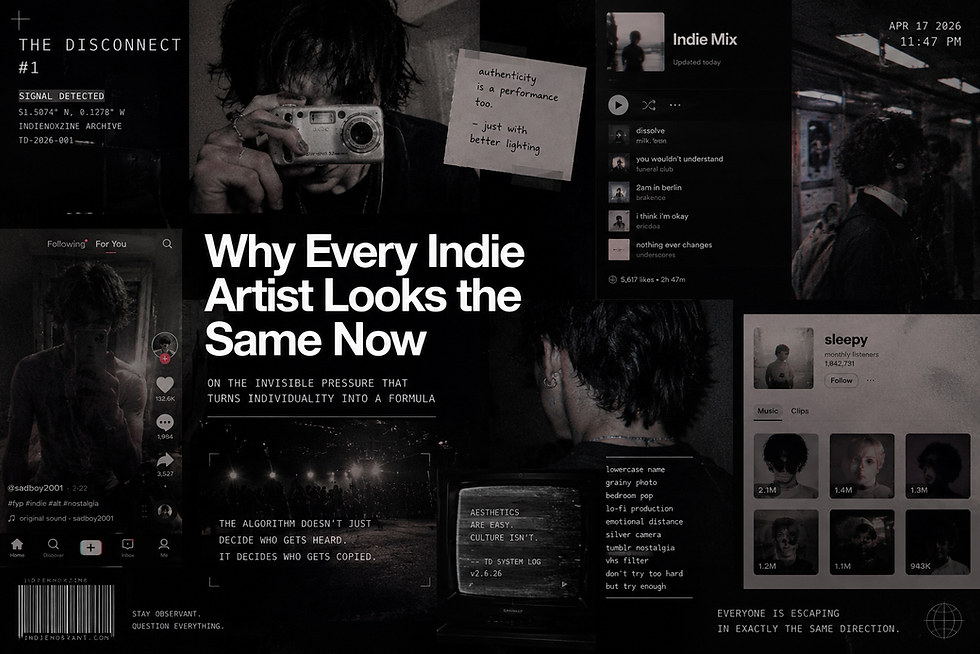
On the invisible pressure that turns individuality into a formula
OPENING TENSION
Alternative culture was built on the promise of escape. Escape from mainstream aesthetics, mainstream sounds, mainstream ways of being seen. But scroll through indie music spaces today, and contemporary indie artist aesthetics start to feel strangely familiar. Everyone is escaping in exactly the same direction.
MAIN THESIS
The algorithm doesn't just decide who gets heard. It decides who gets copied. And right now, it's quietly reshaping what "alternative" even looks like.
DISCONNECT SIGNAL #1
Unpredictability used to be a feature. Now it's a risk.
CULTURAL ANALYSIS
There's a specific aesthetic that dominates underground music spaces right now. Grainy self-shot visuals. Bedroom lighting. Lowercase artist names. Silver digital cameras held at arm's length. A deliberate roughness that signals: I don't care about production. Except someone clearly thought about it. A lot.
Open Spotify. Watch the canvas loops: that two-second blurred flash photograph, the VHS filter, the "accidental" mirror selfie. Scroll through SoundCloud. Notice how many artists share not just a sound, but a posture. Oversized headphones. Breathy, emotionally restrained vocals layered over lo-fi production. The aesthetic of not trying, executed with precision.

This isn't hypocrisy. It's survival.
Platforms reward what they recognize. A sound that fits a mood category gets placed. A visual that matches existing successful content gets shared. An artist who packages themselves legibly gets discovered. The ones who don't - don't. Over time, even emotion itself becomes standardized: sadness performed in recognizable, platform-friendly ways. So artists learn. They study what works. They absorb the codes of their scene and reproduce them, slightly adjusted, as their own. Not because they're fake. Because the system makes legibility a prerequisite for visibility.
DISCONNECT SIGNAL #2
"Authenticity" has become its own visual formula
This isn't new. Subcultures have always had uniforms. Punk had its leather jacket. Shoegaze had its pedal boards and downcast eyes. But there's a difference between a subculture developing its own visual language organically over years and an aesthetic being reverse-engineered from an algorithm's reward structure within months. The speed is what changed everything. Tumblr aesthetics took years to crystallize. TikTok aesthetics take weeks. And when a visual language forms that fast, there's no time for the deeper culture to catch up. You get the surface without the substance. The look without the lineage.

DISCONNECT SIGNAL #3
When an aesthetic forms faster than a subculture can, you get the costume without the community.
The artists caught in this aren't villains. Most of them are doing exactly what any rational person would do when facing an opaque system that controls their reach. They're adapting. They're learning the language. They're trying to be seen.
The question is what gets lost in translation.
Because every hour spent optimizing for recognition is an hour not spent on unpredictability. On the weird detour. On the song that doesn't fit the brand but might be the most honest thing you've ever made.
And those songs - the ones that don't fit - are often the ones that last.
DISCONNECT SIGNAL #4
The most algorithmically illegible artists are often the most historically significant ones.
THE REMAINING QUESTION
If every artist learns how to appear alternative in exactly the same way - what happens to the music that genuinely doesn't fit anywhere?
Maybe the problem isn't that artists stopped being authentic.
Maybe authenticity itself became a genre.
"Artists aren't selling out. They're optimizing in."
THE DISCONNECT #1 - INDIENOXZINE


Comments